



Contact confirmation is not KYC
Two different checks share the word "verify", and mixing them up can lead a player to expect a payout that is still waiting for documents.
| — | Contact confirmation | Full KYC |
|---|---|---|
| When | At registration | When a trigger applies — including any withdrawal |
| What you do | Confirm the phone number and email you registered | Upload a photo ID, a selfie holding it and a proof of address |
| What it proves | The account can reach you | Your identity, age, residence and payment ownership |
| Linked reward | Verification Quest: 10 free spins, 0x, winnings capped at MYR 5 | None |
| Does it release withdrawals? | No | Yes, once approved |
The order is fixed: personal details are filled in, the phone or email is confirmed, a first real-money deposit is made, and documents come only when requested. Completing the Verification Quest is worthwhile, but it does not move you through KYC.
What triggers full verification
The operator names three triggers:
- Lifetime deposits above the equivalent of EUR 10,000. The threshold is expressed in euros in the source; it is not converted to a fixed MYR figure here.
- Any withdrawal request, whatever the amount.
- Suspicious activity detected by transaction monitoring.
Monitoring runs continuously, and the operator can request documents at any time and limit account operations until identity is confirmed. Because any withdrawal request is a trigger, a player who has not crossed the deposit threshold meets the check at the first cash-out, which is why verification is best treated as part of the first withdrawal plan rather than a separate event.
The three documents and what makes each acceptable
1. Photo ID. A government-issued document with a photograph. The name must match the account; the document must not expire within the next three months; it must show the holder is an adult; and it must carry a signature. One document confirms age, identity and the match with your payment details at once, which is why it decides most of the outcome.
2. Selfie holding the same ID. Your face and the document details must both be readable. Its purpose is to show the document belongs to the person applying, not to someone who found or borrowed it.
3. Proof of address. A bank statement or a utility bill, in the same name as the account and the ID, issued within the previous three months. It establishes the country of residence, which ties directly to the platform's geographic restrictions.
| Document | What it proves | Key rule |
|---|---|---|
| Photo ID | Age, identity, payment match | Not expiring within 3 months; name matches; signed |
| Selfie with ID | The document is yours | Face and ID details readable |
| Proof of address | Country of residence | Issued within the last 3 months; same name |
The operator's verification material names the three-month rule on proof of address as the commonest reason for a repeat request. A statement from last year sitting in a folder will not do. A practical habit: download a current statement on the day you request your first withdrawal.
Capturing clear uploads
Most returned documents come from a short list of avoidable faults. The operator's own guidance and the rejection reasons it publishes line up closely:
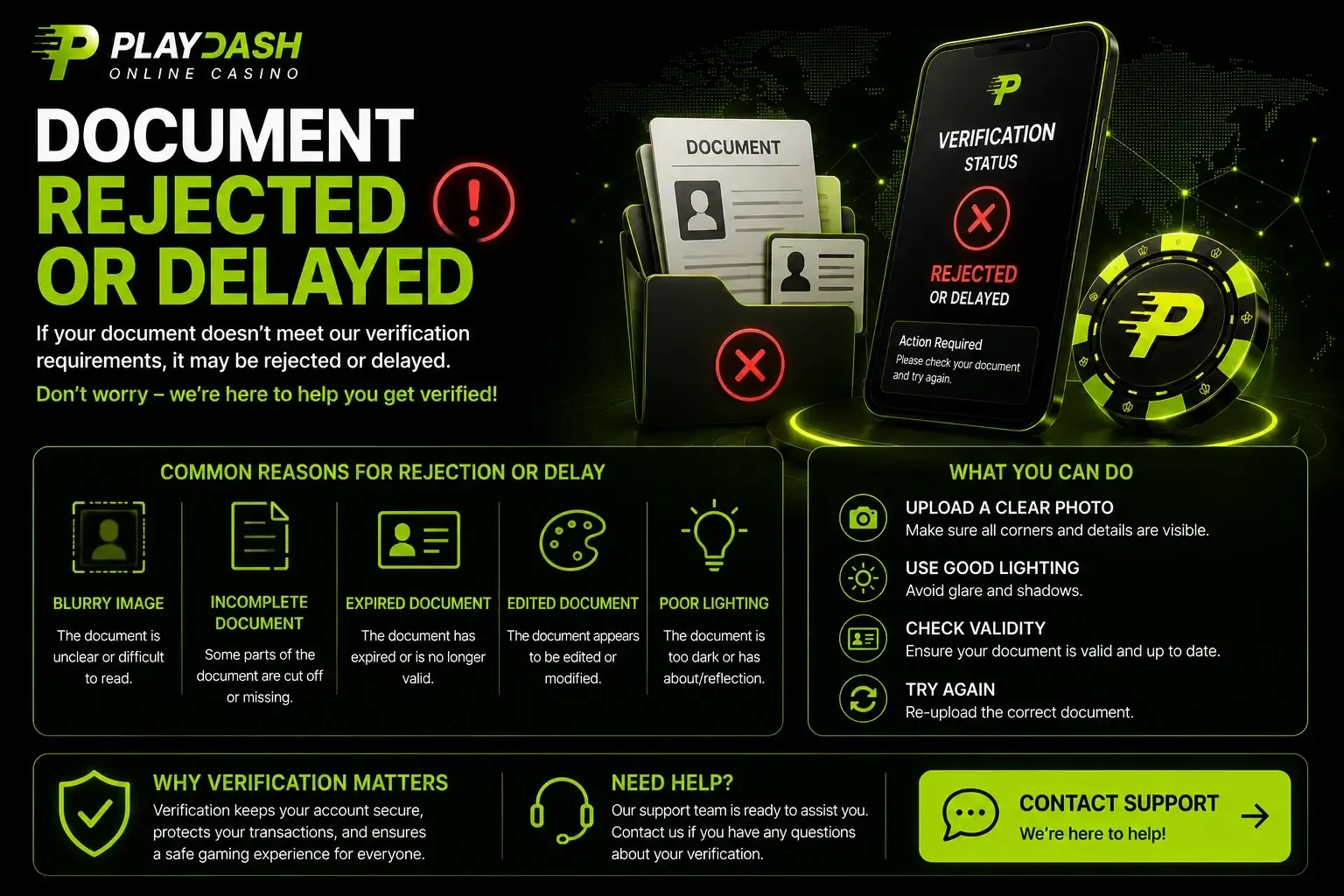
- Cropped edges. Photograph the whole document, all four corners visible.
- Flash glare. Use even daylight or room light instead of the flash.
- Unreadable dates. Check the expiry and issue dates are sharp before sending.
- Angled photos. Hold the phone parallel to the document.
- Edited files. Do not crop, filter or adjust the image; processing raises questions.
- Name mismatch. The name on the ID, the proof of address and the payment method must agree.
Check the selfie for the same faults: if the ID details are unreadable in the selfie, it will come back even if the separate ID photo was fine.
Why some accounts are asked for more
How much is requested depends on a risk level the platform assigns from the pattern of account activity. The player does not choose it.
| Level | When it applies | What is asked |
|---|---|---|
| Simplified | Low-risk cases | Basic identity confirmation |
| Standard | Most players, before a payout | The full three-document set |
| Enhanced | Higher risk or a monitoring flag | Extra detail and source of funds |
Enhanced due diligence is prompted by neutral triggers — large sums, unusual operations or an internal monitoring flag. It is an anti-money-laundering requirement, not an accusation. If you are asked about the source of funds, answer through the operator's specified channel with the documents requested; guessing at what might be wanted usually adds a round.
Returned documents and resubmission
There are three possible outcomes after you submit:
- Approved — with a complete and correct set, the account is verified and the withdrawal can proceed.
- Refused — you receive a written reason and a ticket number, then can submit corrected or replacement documents.
- Requested again later — the operator may ask for documents again at any time and limit operations until identity is confirmed.
When a document comes back, read the reason before reshooting. A returned proof of address because of its date needs a new document, not a sharper photo of the old one. Keep the ticket number and mention it in any follow-up so the new upload is linked to the same case.
When names, accounts or locations do not match
Some holds are not about image quality at all.
Payment ownership. If the withdrawal destination or an earlier deposit came from an account in another person's name, the documents cannot match it. Use accounts in your own name and contact support before introducing a new destination.
Changed details. Legal name, date of birth and payment ownership should match your documents. If your registered phone or email is no longer accessible, contact support through an approved channel; the operator may ask for evidence of ownership but should never ask for your password.
Location. Proof of address establishes residence, and access from a restricted jurisdiction can lead to restrictions on account use or withdrawals until the situation is reviewed. Signing in while travelling can trigger the same location check, because verification may use a broader restricted-country list than the headline one. The operator does not encourage using a VPN to hide your location, and doing so does not remove the need for the review.
Duplicate accounts. Each person may hold a single account. When two profiles share an IP address, a device or a payment method, the operator can treat them as duplicates, and opening another account never solves a verification problem.
Returning after a long gap. If an account has been unused for months, documents that were valid at the first check may have expired since. A withdrawal after a long break can therefore bring a fresh request for a current ID or proof of address — and an account left without deposits, bets or withdrawals for 12 months becomes dormant and starts paying a EUR 6 monthly maintenance fee seven days after notice. Checking document expiry dates before you return saves a round.
Handing a verification issue to support
Support is published as available through 24/7 live chat, the Customer Support menu, the official Telegram presence and email, in English. For a verification question, include the account login or registered contact, the ticket number if you have one, which document was returned and the reason given. Upload documents only through the channel the operator specifies, and never send a password or one-time code. This guide takes no part in the check and cannot affect its result.
Questions readers ask
Do I need documents to sign up?
No. Documents are requested when a trigger applies, and any withdrawal request is a trigger.
Does the Verification Quest count as KYC?
No. It confirms your phone and email and is listed with 10 free spins (0x, winnings capped at MYR 5). KYC is the separate document check.
How recent must my proof of address be?
Issued within the previous three months.
My ID expires in two months. Will it be accepted?
The published rule is that the ID must not expire within the next three months, so it is likely to be returned. Use a document with longer validity.
What happens if my documents are rejected?
You receive a written reason and a ticket number and can resubmit corrected documents.
Can the operator ask again after I am verified?
Yes. Documents can be requested again at any time, and operations can be limited until identity is confirmed.
Getting verified before you need the money
The quickest first payout belongs to a player who verified early: ID with more than three months' validity, a selfie where the ID can be read, a statement or bill from the last three months, and payment accounts in the same name. With that done, return to the withdrawal guide to plan the request around the daily limits. If the problem is getting into the account at all, the account access guide covers recovery, and the overview shows where verification sits in the full deposit-to-payout route.